
Why was the Nador LNG project put on hold on the eve of the tender opening?
Economy of the East
The sudden suspension of the requests for proposals for the Nador LNG terminal and gas pipelines on Monday, February 2, 2026, has raised eyebrows in Moroccan and international energy circles. This last-minute decision before the opening of the bids revealed failures in planning and coordination within Leila Benali's Ministry of Energy Transition and Sustainable Development, which wanted to move forward with the project without adequate consultation or a solid technical framework.
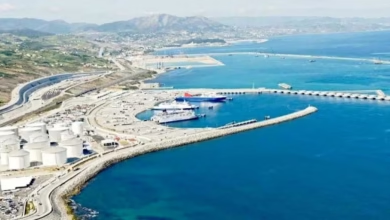
The project was to include a liquefied natural gas (LNG) terminal at the Nador WestMed port, with a capacity of 500 million cubic feet per day, equivalent to about 5 billion cubic meters per year. This capacity is equivalent to five times the current national consumption. The project also included a network of several hundred kilometers of gas pipelines to connect these pipelines to the Morocco-Europe pipeline, which crosses Morocco from Ain Beni Mutahar on the eastern border to Tangier in the far northwest.
Ministerial and Finance Committee Reservations
From the earliest stages, even before the launch of the prequalification tender on December 5, 2025, reservations were raised about the financial estimates provided by the Ministry of Energy Transition. The ministerial committee in charge of examining PPP projects issued negative remarks in its prequalification report. This procedure, regulated by Law No. 86-12, is mandatory for all projects that seek to be realized under a public-private partnership (PPP).
The committee noted in particular the financial viability of the proposed structure, especially the costs of running the gas pipelines, which have been estimated at around 1 billion dirhams per year, without clearly defining who would bear this cost under an undefined partnership. Sources from the petroleum sector also raised the issue that this infrastructure, designed for a flow of 8 to 10 billion cubic meters per year, may face technical issues with the flow given the current weak demand for gas in the Kenitra and Mohammedia regions.
The maximum capacity of the Mohammedia and Kenitra power plants, with a capacity of 300 megawatts each, is estimated at 200 million cubic meters of gas per year. This figure is insignificant compared to the capacity of the proposed pipeline, making the project oversized and generating high operating costs that will drive up the price of gas.
Lack of consultation with key stakeholders
According to multiple sources, the project was prepared without adequate dialog with key players in the sector. The National Office of Hydrocarbures and Mines (ONHM), which possesses national technical expertise in the field of gas and ensures through its branch the transportation of LNG purchased from Spain to the plants of the National Office of Electricity and Drinking Water (ONEE), was marginalized. The ONEE, Morocco's main gas consumer with more than 900 million cubic meters per year, was also not included in the initial arbitrations.
Another actor that has been excluded from the discussions, or at least marginalized, is the Ministry of Economy and Finance. On January 20, 2026, the Minister of Finance issued a negative opinion on the project, specifically targeting the pipeline portion of the PPP. The ministry criticized the launch of the request for proposals without prior validation of the project's eligibility for partnership, especially in the absence of a clear definition of the responsible public entity and a balanced distribution of risks, warning of budgetary and legal risks in the absence of a gas law.
Project halted after royal meeting
This official rejection from the Ministry of Finance did not lead to an immediate suspension of the prequalification application. It had to wait for the royal meeting dedicated on January 28, 2026 to the Nador WestMed port project for the Ministry of Finance's reservations to resonate. In the end, the Ministry of Energy Transition suspended the application on the eve of the opening of tenders, not only for the pipeline part, but also for the floating regasification plant (FGRP) component, the key element of the entire system.
The LNG terminal, to be built at the Nador West Med port, was to be the first sovereign entry point for liquefied natural gas (LNG) in Morocco. This infrastructure was designed to receive methane tankers, store the LNG and convert it back to its gaseous state to supply the ONEE's power plants and national industrialists located near the pipeline route. The plant was scheduled to enter service in 2027.
Optimistic Gas Demand Estimates
The suspension of all components of the prequalification request initiated by the Ministry of Energy Transition puts the entire gas strategy into question, especially the technological options and consumption assumptions presented by the ministry. The ministry's optimistic figures, with an internal demand of 10 billion cubic meters by 2030-2031, seem hard to defend.
In recent years, national gas consumption does not exceed 1 billion cubic meters per year, mainly to supply the two power plants connected to the Morocco-Europe pipeline. National production, which is destined for industry, remains negligible (less than 50 million cubic meters in 2024). Imports through Spain have never exceeded 930 million cubic meters, according to Spanish figures. In these circumstances, even the current consumption figure of 1.2 billion cubic meters is difficult to verify.
The main ongoing project is the Wahda plant (1000 MW), which is expected to go into production, at the latest, in the second quarter of 2027, and is designed to operate in peak mode with a maximum load of 30 percent, meaning limited gas consumption of an additional 300-400 million cubic meters in 2027. The other project is the expansion of the Tahdart plant to 1500 MW, programmed around 2029-2030, but it remains subject to several technical uncertainties, especially related to the supply of turbines in a tense international market due to the high demand for this equipment.
The third project is the combined cycle gas plant in Nador, for which impact studies began last January and which is scheduled for 2030 with a nameplate capacity of 1,200 megawatts. However, little information is available on this project, and delays in the port's energy project inevitably entail delays in bringing this plant into production.
Overdue regulatory framework
According to sources, Morocco could reach a demand of 4 billion cubic meters of gas for electricity production by 2030. Industrial consumption is currently weak. Even if energy-intensive projects are not lacking, an efficient and cheap gas transportation infrastructure, backed by clear resources over time, remains a prerequisite for the transition to this energy source.
A clarity that can only be ensured by a clear regulatory framework, governance and organization. A sovereign task for the government and the Ministry of Energy Transition, which seems to be lagging behind, especially in the operationalization of Law 67-24. The draft law was subject to public consultation at the end of 2024 and is supposed to frame the national strategy for natural gas, including import, storage and transportation, as well as regulating pricing and access to the grid.