
Nador West Mediterranean: Three integrated projects to be operational by the end of 2026
Oriental Eco
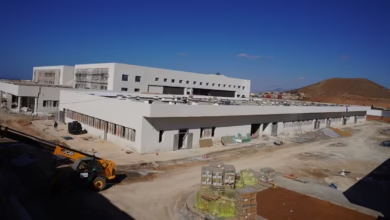
King Mohammed VI monitored the progress of the Nador West Mediterranean Industrial Complex and Port, which is set to be operational by the end of this year. According to the communiqué issued after the meeting, the pace of work is progressing and the deadline for the launch of the port's activities is expected to be met.
The Nador West Mediterranean Industrial Complex and Port project is one of the strategic projects in the eastern region, for which public authorities have set three main goals: accelerating the economic and social development of the region, strengthening Morocco's maritime role in the Western Mediterranean region, and ensuring the supply of energy products such as natural gas and coal to the Kingdom.
Deep-water port with various capacities
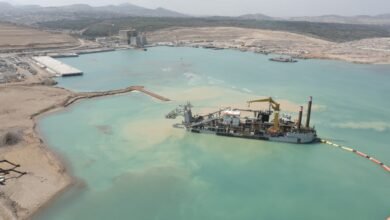
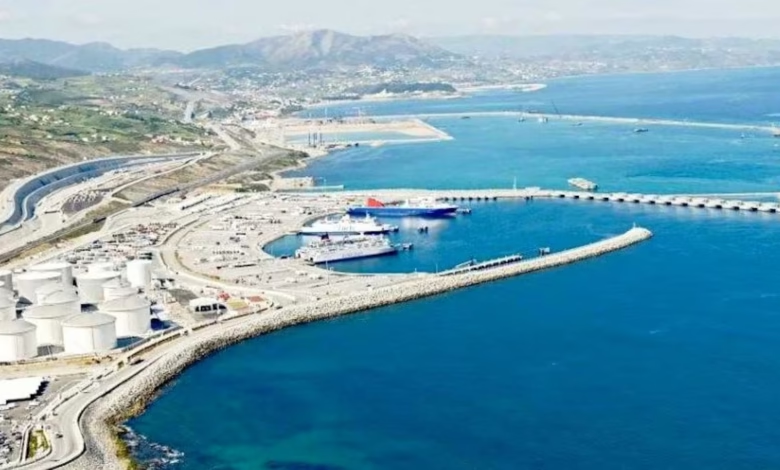
The Nador West Mediterranean Complex consists of three integrated projects. The first project is a deep-water port, where the first unit includes a main bulkhead of about 4,200 meters in length and a counter-barrier of 1,200 meters in length.
This port includes several specialized terminals. A container terminal with a 1,520-meter-long, 18-meter-deep berth and a 76-hectare land area, with the possibility of adding another 1,200-meter-long berth. A fuel terminal with three oil berths with a depth of 20 meters. A coal terminal with a 360-meter-long and 20-meter-deep berth. In addition to a miscellaneous terminal, a marina, and a service berth.
In terms of capacity, this structure will be able to handle 3 million containers per year, with the potential to increase this capacity by an additional 2 million containers, 25 million tons of fuels, 7 million tons of coal, and 3 million tons of miscellaneous cargo.
Industrial acceleration zones on an area of 2000 hectares
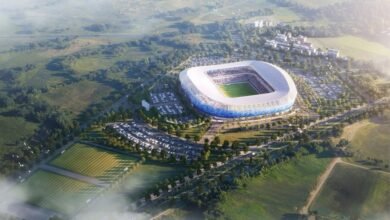
The second project concerns the creation of industrial, logistics and service zones on the free zone adjacent to the port and on the 2,000-hectare development zone. It includes three industrial acceleration zones: A logistics zone, a zone for the storage of fuels and chemical products, and a diversified industrial zone.
The promotion and management company BITOYA Industrial and Logistics will host industries in multiple sectors. These include automotive construction and subcontracting, chemical and semi-chemical industry, renewable energies, light industry such as textile, electrical and electronics, and commercial logistics.
According to the financial study carried out, the 25-year (2025-2050) occupancy rate projections for these areas will enable them to generate revenues at a rate of return of 8.3%. It is also expected to create 120 jobs per hectare with an average annual wage of 80,000 dirhams, with a total economic return of 19,61%.
Floating regasification unit
The third project is for the Kingdom's first regasification terminal, which is expected to enter service in 2027. It relates to a floating storage and regasification unit that will be installed inside the port to receive LNG.
It will have a nominal regasification capacity of 5.1 billion cubic meters per year, with the potential to reach 7.5 or 7.8 billion cubic meters. It will be connected to the Morocco-Europe gas pipeline with an extension to the industrial zones of Kenitra and Mohammedia.
The unit aims to reduce dependence on energy imports and supply the Ain Beni Mutahar and Tahdart plants, as well as the thermal plants in Kenitra and Mohammedia that are being converted to run on gas.