
The East is a global destination for vertebrate paleontology research
Oriental Eco
The soil of Morocco's eastern region harbors exceptional geological treasures that span millions of years and recount the history of life on Earth. In this context, the Faculty of Science at Mohammed I University in Oujda hosted the Third International Symposium on Vertebrate Paleontology in North Africa, which was a prominent scientific station to highlight the paleontological wealth of the region and emphasize its pivotal role in understanding the biological evolution of the African continent.
For several days, researchers, experts and students from around the world came together to explore the rich fossil reserves of eastern Morocco, in a scientific meeting that aspires to turn this geological heritage into a real lever for sustainable development. After twenty years of field excavations, successive discoveries, and fruitful international cooperation, the eastern region has established itself as a reference destination in the map of geological memory of the African continent.
The choice of Oujda to host this international forum after Marrakech and Ouarzazate was not arbitrary, but rather the culmination of the distinguished scientific status of the Eastern Province in the field of paleontological research at the level of North Africa. The region boasts a unique fossil record that testifies to hundreds of millions of years of life evolution, making it comparable to major reference sites such as Casablanca's Ain Aglam and other North African sites. In addition to providing a platform for scientific dialogue between researchers and students, the forum aims to assess the current state of knowledge and the latest discoveries related to vertebrate fossils in North Africa, while emphasizing the need to value, protect and preserve this natural heritage for future generations.
The oldest vertebrate fossils discovered in the region date back to the beginning of the Devonian period, about four hundred million years ago. The newly discovered sites in the Eastern Province are characterized by an exceptional state of preservation and open up promising prospects for a deeper understanding of the remains of the first vertebrates that lived on Earth. This geological richness makes the eastern region a key to understanding the evolution of vertebrates in parallel with the major geographical and environmental shifts that have characterized the history of the Earth through different eras, explains Hassan Oragh, president of the forum.
Lionel Cavan, Curator of the Natural History Museum in Geneva, emphasized the great importance of this scientific meeting due to the opportunities offered by being in a country rich in important fossil sites spanning from the Paleozoic to the Cenozoic. This temporal diversity gives researchers a rare opportunity to study the fossil record across extended geological periods.
The organizers have set four main objectives for this scientific forum. The first objective is to monitor the latest discoveries and scientific progress in this field, while the second objective focuses on promoting scientific exchange and research partnerships between researchers, especially between the African, European and American continents. The other two objectives relate to the valorization of the paleontological heritage of the Moroccan East and the involvement of young researchers and Moroccan students in high-level scientific research.
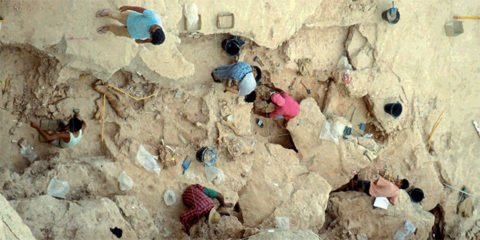
After two days full of scientific interventions and discussions on eight thematic topics, the participants moved to the field for two expeditions. The first led them to the caves of Hammam, Tafougalt and Zakzel, which are true archaeological and natural treasures. The second trip was in the footsteps of the dinosaurs in Tendrara, an exceptional site that testifies to the greatness of the region's paleontological heritage.
The participation of fifty-two researchers from Switzerland, France, Tunisia, the Netherlands, Spain, Brazil and Australia alongside Moroccan academics to present the results of their recent research is of paramount importance for scientific research in this field of knowledge. This international presence allows to strengthen the international scientific research network and stimulate new collaborative projects, as the proceedings of the meeting will be published in a peer-reviewed international journal.
On a formative level, this meeting contributes to the involvement of Masters and PhD students at Mohammed I University in the organization of specialized scientific meetings, while contributing to the recognition and preservation of the rich local paleontological heritage. Positive media coverage enhances the attractiveness of the university and the eastern region in general.
Recent discoveries of new fossil sites confirm this research dynamic, with more than thirty paleontological and archaeological sites identified in the region, some of which are in an excellent state of preservation. Among the notable discoveries are complete skeletons of large mammals such as the rhinoceros at Kfayet, as well as large species previously unknown in Morocco such as the wild bison and the Tilsint crocodile, among others.
The scientific progress achieved and the partnerships forged during this forum open up promising prospects for future research in this field. Through this initiative, Mohammed I University reaffirms its central role in understanding the evolutionary history of life on the African continent, and puts the Eastern Province on the global scientific research map as a pivotal region for the study of the Earth's geological past.