
Dams in the East: 3 projects underway to address erratic rainfall
Oriental Eco
The filling rate of the dams in the Mellouya water basin reached 319 million cubic meters as of Tuesday, January 13, representing 40% of their capacity. The East Region is counting on its new dams to take advantage of irregular rainfall and secure its water supply, in light of the climatic challenges facing the region.
The three main dams in the basin recorded a total volume of 152.72 million cubic meters in the Oued Za dam, 79.23 million cubic meters in the Mohamed V dam, and 74.33 million cubic meters in the Hassan II dam. The storage curves show a balance compared to the previous two years during the same period, as the dams were able to replenish their water resources despite the daily consumption.
Reassuring water situation despite not reaching the annual average
December's rains revived hopes despite not reaching the annual average. The Mellouya Water Basin Agency explained that “to make a reliable forecast for the rainy season, we need to wait until the end of March, as rainfall accumulations could improve during the winter.” The situation is considered positive in terms of securing and enhancing water resources in the face of climate change.
To improve the utilization of rainfall, works are currently underway to strengthen the water infrastructure through the construction of the Targa Omadi dams in the Kersef region and Beni Azziman in the Dreyoush region, in addition to raising the height of the Mohamed V dam in the Nador region to increase its storage capacity from the current 800 million cubic meters to about 1.936 billion cubic meters when the works are completed.
Mohammed V Dam: Raising the bar to meet the challenges
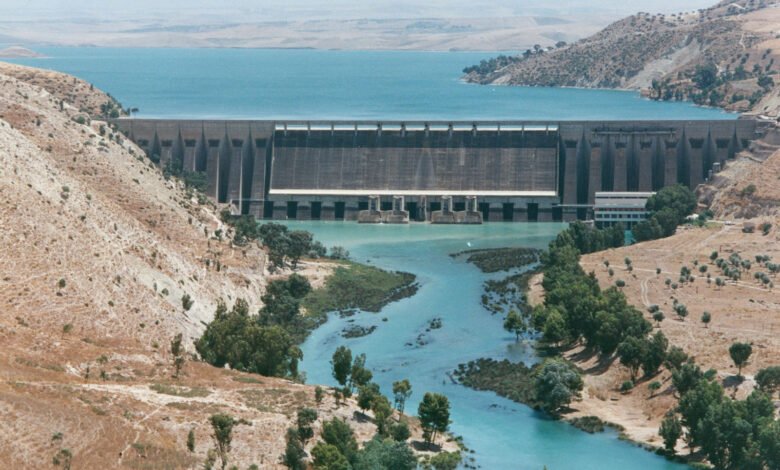
The project to raise the height of the Mohammed V Dam responds to two main objectives. The first is to overcome the issue of its low storage capacity, which has declined due to drought and sedimentation from the original 730 million cubic meters to only 239 million cubic meters. The second aims to take advantage of its strategic location and proximity to agricultural areas.
The Mohammed V Dam is the most important water facility in the eastern region and one of the oldest dams in Morocco. It entered service in 1967 on the Mellouya Valley, and its storage capacity gradually declined over the decades, affecting the distribution of irrigation water and agricultural development. The dam contributes to the socio-economic development of the region by producing 23 megawatts of hydroelectric power and providing potable and irrigation water, especially by diverting its resources to the Mchraa Hammadi Dam.
This led the Ministry of Equipment and Water to launch a project to raise the height of the dam to 67.4 meters instead of the current 55.4 meters, with the aim of reaching a total storage capacity of 950 million cubic meters by 2026, compared to about 240 million cubic meters currently. The elevation work is well advanced and is expected to be completed by the end of 2026. This project started in April 2021 at an estimated total cost of 1.55 billion dirhams.
Beni Azziman Dam to secure water in Drouiche
The irregular rainfall in the Dreouche region necessitated the construction of water infrastructure to meet drinking and irrigation needs, while minimizing losses due to runoff to the basins and the sea. The Beni Azziman dam is 70 meters high with an estimated storage capacity of 44 million cubic meters, and aims to irrigate livestock, supply the region with potable water and irrigate agricultural lands downstream, in addition to protecting the lower areas and Medar center from flood risks.
This infrastructure is essential for the valorization of small and medium irrigation areas and enhancing resilience to droughts. The project requires an investment of 1.4 billion dirhams and is part of the National Potable Water Supply and Irrigation Program 2020-2027. It is expected to be operational by the end of this year.
Targa Omadi Dam to secure water supply in Kersef
The construction of the 1.45 billion dirham Targa Omadi Dam aims to secure water reserves and provide drinking water to the population of the Kercef region, at a cost of 1.45 billion dirhams. It will play an important role in seasonal agricultural irrigation and fruit trees such as olives, almonds, peaches, plums, apricots and vines, making the project a lever for socio-economic growth while mitigating the effects of climate change and the scarcity of precipitation.
In terms of storage capacity, it is the second largest dam in the region with 287 million cubic meters and an annual flow of 81 million cubic meters. It is scheduled to be delivered by the end of 2026. Through the construction of these three dams, the Eastern Province seeks to control the irregularity of rainfall and the runoff of water towards the sea.